- Introduction
- Men's watch
- ALPINA
- ARMANI EXCHANGE
- ATLANTIC
- BURBERRY
- BREITLING
- CALVIN KLEIN
- CASIO
- CERTINA
- CITIZEN
- DANIEL WELLINGTON
- DIESEL
- DOLCE GABBANA
- EDOX
- EMPORIO ARMANI
- FESTINA
- FREDERIQUE CONSTANT
- FOSSIL
- GARMIN
- GUCCI
- GUESS
- HAMILTON
- INVICTA
- JAGUAR
- LONGINES
- LUMINOX
- MAURICE LACROIX
- MARC JACOBS
- MASERATI
- MONTBLANC
- MICHAEL KORS
- NAUTICA
- ORIENT
- OMEGA - SWATCH
- PHILIPP PLEIN
- PIERRE CARDIN
- POLICE
- ROAMER
- SAMSUNG
- SEIKO
- STORM
- SWISS MILITARY HANOWA
- TAG HEUER
- TISSOT
- TIMBERLAND
- VERSACE
- VICTORINOX
- VOSTOK
- VULCAIN
- ZEPPELIN
- All men's watches
- Women's Watch
- ALPINA
- ARMANI EXCHANGE
- ATLANTIC
- BURBERRY
- BREITLING
- CALVIN KLEIN
- CASIO
- CERTINA
- CITIZEN
- CLUSE
- DANIEL WELLINGTON
- DKNY
- DOLCE GABBANA
- EDOX
- EMPORIO ARMANI
- ESPRIT
- FESTINA
- FREDERIQUE CONSTANT
- FOSSIL
- GARMIN
- GUCCI
- GUESS
- HAMILTON
- INVICTA
- JAGUAR
- LONGINES
- LUMINOX
- MARC JACOBS
- MASERATI
- MICHAEL KORS
- NAUTICA
- ORIENT
- OMEGA - SWATCH
- PHILIPP PLEIN
- PIERRE CARDIN
- TAG HEUER
- TISSOT
- TIMBERLAND
- SAMSUNG
- SEIKO
- SKAGEN
- STORM
- SWAROVSKI
- SWISS MILITARY HANOWA
- VERSACE
- VERSUS VERSACE
- VICTORINOX
- ZEPPELIN
- All ladies watches
- Children's watch
- Watch category
- Accessories
- Brands
- ALPINA
- ARMANI EXCHANGE
- ATLANTIC
- BREITLING
- BURBERRY
- CALVIN KLEIN
- CASIO
- CERTINA
- CITIZEN
- CLUSE
- DANIEL WELLINGTON
- DIESEL
- DOLCE GABBANA
- DKNY
- EDOX
- EMPORIO ARMANI
- ESPRIT
- FESTINA
- FREDERIQUE CONSTANT
- FOSSIL
- GARMIN
- GUCCI
- GUESS
- HAMILTON
- INVICTA
- JAGUAR
- LUMINOX
- MAURICE LACROIX
- MARC JACOBS
- MASERATI
- MONTBLANC
- MICHAEL KORS
- NAUTICA
- ORIENT
- Omega - SWATCH
- PANDORA
- PHILIPP PLEIN
- PIERRE CARDIN
- POLICE
- ROAMER
- SAMSUNG
- SEIKO
- SKAGEN
- STORM
- SWAROVSKI
- SWISS MILITARY HANOWA
- PIERRE CARDIN
- TAG HEUER
- TISSOT
- TIMBERLAND
- VERSACE
- VERSUS VERSACE
- VICTORINOX
- VOSTOK
- VULCAIN
- ZEPPELIN
- LONGINES
- SALE
- In stock
- TOP 10
- Blog


Water resistance
The situation regarding the water resistance of the watch could be called so, but it is by no means clear and easy to understand. Once you understand the numbers on water resistance or waterproofness, interpretation and implementation play an important role. Who wouldn't want to have a clear view of the waterproofing rate when choosing a watch. Is a watch with 3ATM leakproofness enough, or are those with 100M better? The following text may be helpful to clarify the issue of the relationship between watches and water.
What needs to be mentioned right at the outset is that the term "watertight" does not correspond to reality in terms of watches. Even the best watches used for diving are not always tight enough. Guidelines issued by the US Federal Trade Commission (FTC) do not even recommend that manufacturers label watches as waterproof. The recommendation is not mandatory, resulting in the use of both terms.
The new terminology introduced the term "waterproof". To avoid inconsistency of interpretation, lower levels of water resistance were standardized in 1990 by ISO 2281 and higher levels of "water resistance" were standardized by ISO 6425 in 1996. In general, ISO tests involve alternating temperatures, depths. , pressures (water, air) for varying periods of time at rest and handling the operating parts of the watch. In the case of deep diving watch models, an additional test is carried out for salt water resistance and the watch's ability to cope with overpressure (decompression simulation). An illustrative breakdown of the standards can be found in the attached table.
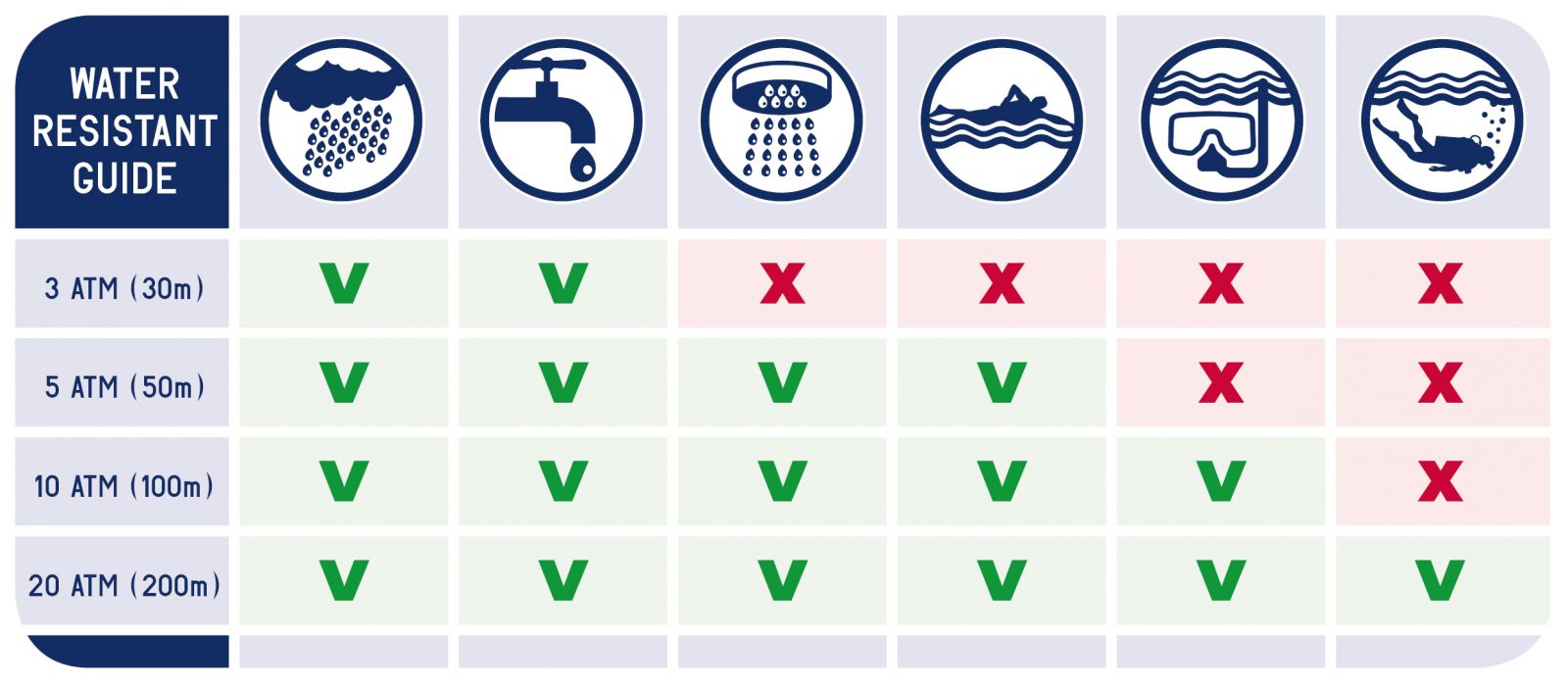
It is clear from the table that a universal unit for waterproofing cannot be used. Most often you will find the mark in meters, feet (M, ft) or atmospheric pressure units (ATM, BAR). It is the pressure that can affect the penetration of water inside the watch. Over the years, watch protection systems have continuously improved. The screw-down crown, used as early as 1926 for the Oyster model of the famous Rolex brand, seems to have played an important role. Other important elements for good water resistance are rubber or Teflon ring seals, hardening liquid applied to the case, screw cap, pressure valve and others. By combining these elements, watch manufacturers obtain excellent water protection parameters.
No watch, regardless of its quality, can guarantee that it will retain its waterproofness forever. As with any consumer product, certain principles apply. In a nutshell, it comes down to underestimating the given design features.
Details below:
- a pressure test must be carried out every year and after each cover opening
- it is not recommended to handle the crown of the watch (even the threaded one) or the pushers under water
- sudden changes in temperature cause differential expansion of the material and precipitation of residual moisture on the glass
- after being in salt water or heavily mineralised water, the watch should be washed under a stream of clean water
- avoiding shocks under water and dropping the watch on a hard surface
- avoid contact of the watch with aggressive chemicals (applies to watches in general)
Add new comment:
Add reply to comment: